





A blockbuster listing crowns China’s hottest AI-chip bet
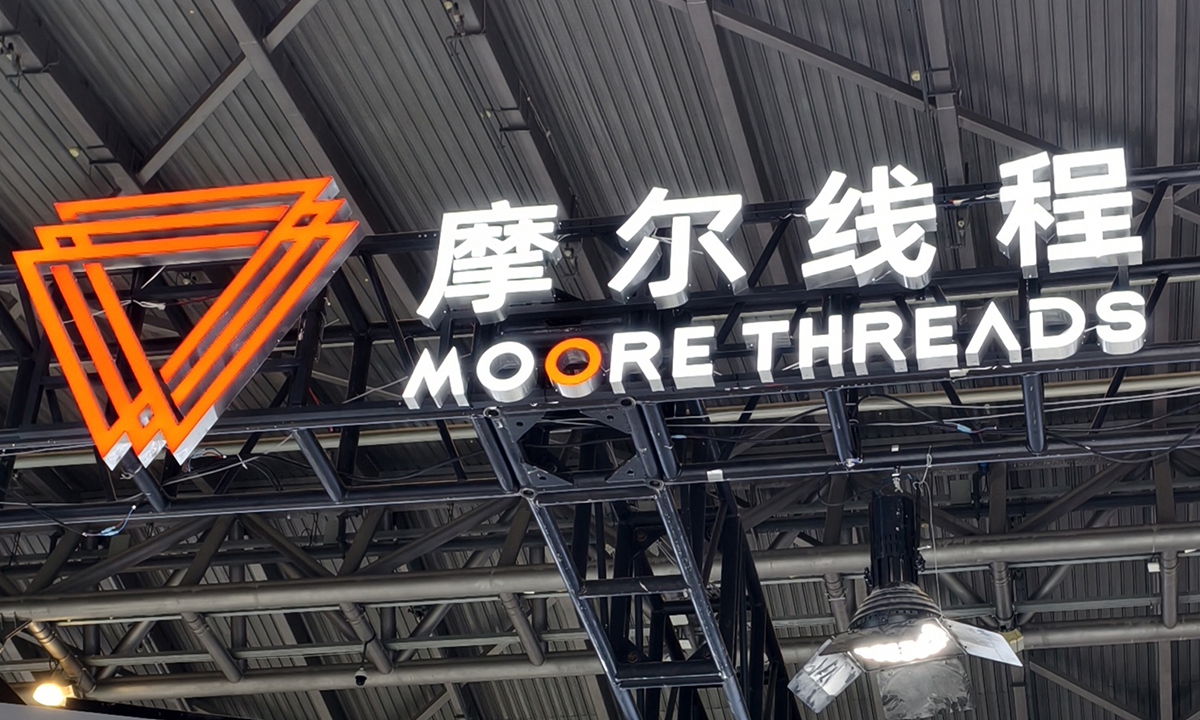
Moore Threads, often called “China’s Nvidia,” delivered a stunning Shanghai STAR Market debut this week. The GPU and AI-chip designer raised about US$1.1 billion in its initial public offering, then saw shares jump roughly 425% on day one, closing around five times above the IPO price. The rally was not a random pop. It reflected a deep pool of domestic capital that is actively hunting for national-champion chipmakers, especially as export controls keep tightening around advanced AI hardware. In that context, Moore Threads has become a symbol of where China wants to go: away from dependence on foreign GPUs and toward a homegrown stack that can power its AI economy at scale.
Built by ex-GPU veterans, shaped by the export-control era
Moore Threads was founded in 2020 by Zhang Jianzhong, a former senior leader at Nvidia’s China business. Several other founding engineers also came from Nvidia and global hardware firms, giving the start-up instant credibility in a field where experience is scarce. The company began with gaming-oriented GPUs, then pivoted quickly into AI training and inference chips as China’s model boom accelerated.
Yet Moore Threads’ rise has happened under unusually harsh conditions. In 2023, the firm landed on the U.S. entity list, cutting it off from key foreign technology inputs and advanced foundry access. That forced a shift toward domestic manufacturing partners and a more self-contained supply chain. The technical cost has been real. Leading-edge fabrication is still difficult inside China, and domestic processes lag the most advanced global nodes. Even so, the export-control squeeze has created a powerful demand pull for local alternatives. Every restriction on imported AI GPUs enlarges the addressable market for firms like Moore Threads, even before they fully match global performance.
Financially, the company is still early in its climb. It remains loss-making, though revenue has been rising quickly as AI demand spreads across cloud, industrial, and government buyers. Regulators fast-tracked the IPO under STAR Market rules that allow strategic tech firms to list before turning profitable, a policy meant to shorten the capital runway between lab development and large-scale production.
Capital for R&D, ecosystem building, and scale-ready production
The IPO proceeds are earmarked for the expensive parts of the roadmap. Moore Threads wants to push next-generation GPU architectures, improve software tooling, and deepen compatibility across China’s growing AI stack. Hardware alone is not enough in GPUs. The winner also controls the developer ecosystem, compilers, libraries, and training pipelines that make chips usable at scale.
In practical terms, Moore Threads is trying to build a domestic equivalent to Nvidia’s CUDA-anchored ecosystem. It has already released multiple GPU generations and is positioning its newest AI chips for data-centre workloads, including large-model training and high-throughput inference. The company is also expected to invest in partnerships with Chinese cloud providers, server makers, and AI labs to make sure its chips sit inside real deployments rather than remaining showcase prototypes.
The listing itself strengthens this strategy. A public-market valuation gives Moore Threads a currency for recruiting senior engineers, supporting longer R&D cycles, and funding tool-chain work that may not pay off for years. In a geopolitically fragmented chip world, that kind of long-duration capital matters as much as the chips.
The surge is about state-backed conviction, not near-term parity
A 425% first-day surge is extraordinary by any market standard. It tells us that investors are buying a strategic narrative as much as a balance sheet. Moore Threads is nowhere near Nvidia in scale, performance, or ecosystem depth, yet its debut shows that China’s capital markets are willing to price in future national value aggressively.
This is not purely market exuberance. It is a reflection of policy reality. China’s AI economy is growing fast, while access to top-tier foreign GPUs is shrinking. That forces domestic buyers to take local hardware seriously, even if performance per watt or software maturity is still catching up. In that environment, Moore Threads benefits from being early, visible, and aligned with Beijing’s self-reliance priorities.
The debut also sets a benchmark for a broader wave of Chinese AI-chip firms heading to public markets. If one local GPU champion can command this level of demand, others will follow, and capital will keep flowing into the domestic compute stack. Over time, that could compress China’s innovation cycle, because public money arrives earlier and at larger scale than private rounds typically allow.
Still, the surge raises expectations. Public markets do not reward strategic alignment alone forever. They will eventually want proof of competitive performance, stable shipments, and defensible gross margins. Moore Threads must show that it can win real workloads, not just patriotic headlines.
A long race where software and manufacturing decide the ceiling
The next two years will determine how high Moore Threads can realistically climb. On the demand side, the runway looks strong. China’s AI spending remains large and is spreading beyond cloud giants into manufacturing, transport, finance, and government. As long as restrictions keep foreign AI GPUs scarce, domestic demand will stay willing to trial local chips.
The harder part is supply-side execution. First, Moore Threads must keep improving the performance-to-cost ratio of its GPUs under domestic manufacturing constraints. Second, it must deepen its software platform fast enough that developers can port models without heavy friction. Third, it needs reliability at scale, because data-centre buyers care about uptime and predictable throughput more than novelty. If Moore Threads delivers on those three fronts, it can use this IPO momentum to become a default choice for a wide slice of China’s AI workloads. If it does not, the company risks being trapped as a second-tier alternative.
For Asia, the stakes are broader. A successful Moore Threads would show that a large domestic market, paired with policy-aligned capital, can nurture serious GPU challengers even in a bifurcated tech world. That would reshape how regional supply chains and AI platforms choose their compute base.
A market debut that turns China’s chip ambition into a public-market mandate
Moore Threads’ first-day surge is not just a flashy IPO story. It is a clear sign that China’s investors are underwriting a long, expensive push for GPU self-sufficiency. The company now has US$1.1 billion in fresh capital and a public valuation that reflects strategic faith in domestic AI hardware. The opportunity is huge, because China needs local compute at scale. The responsibility is equally large, because public markets will soon demand proof that Moore Threads can translate ambition into performance, ecosystem depth, and dependable production. For now, the debut delivers a powerful headline: China’s GPU race has entered a new, highly funded phase.