





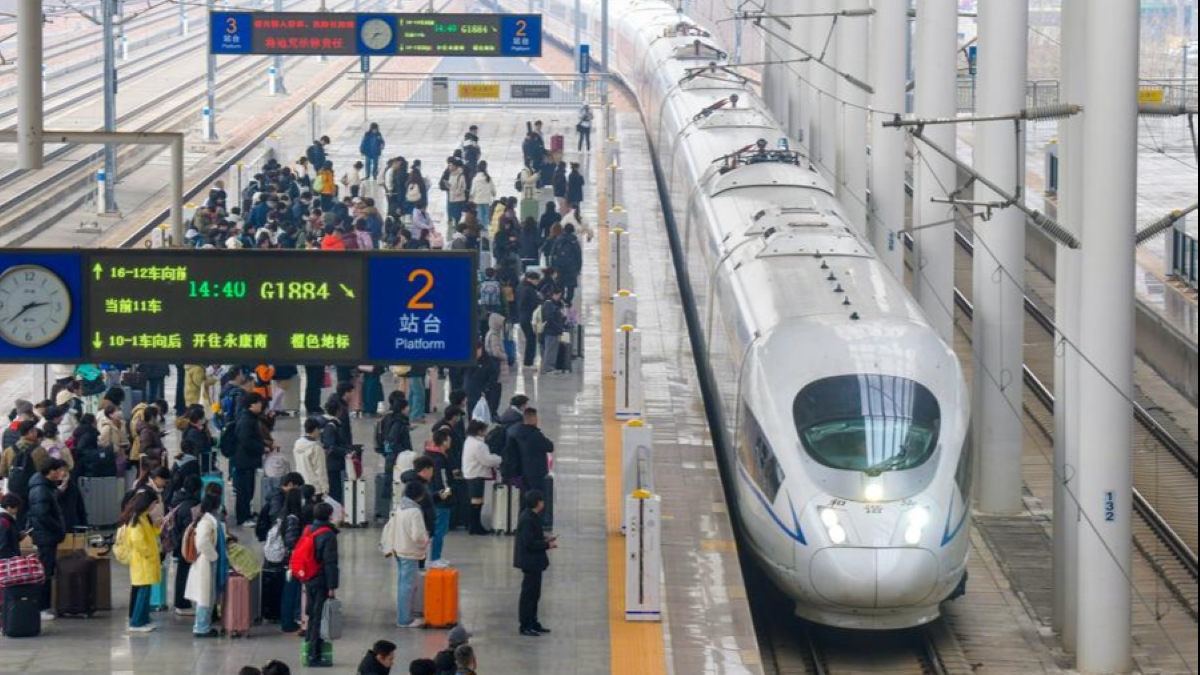
Golden week sparks record-breaking travel
China’s national railway recorded 23.13 million passenger trips on the first day of its extended Golden Week holiday, marking a new single-day high. The surge highlights not only the scale of China’s domestic mobility but also the rebound in consumer confidence and short-haul tourism.
As borders remain selective for outbound travelers, China’s vast domestic transport system has become a key outlet for leisure, family visits, and cultural exploration.
Golden week as China’s travel engine
Golden Week, which coincides with National Day celebrations, has long been one of China’s busiest annual travel seasons. This year’s holiday was extended to eight days, blending National Day with the Mid-Autumn Festival.
Rail remains the backbone of this travel surge. The China State Railway Group mobilized additional high-speed trains and expanded service hours to cope with passenger volumes. Major routes between Beijing, Shanghai, Guangzhou, and Chengdu saw near-capacity bookings days before the holiday began.
The record-breaking 23.13 million trips reflect how Chinese households are prioritizing travel experiences after years of pandemic restrictions. For many, rail journeys are faster and more affordable than flights, particularly for intercity or provincial routes.
Meeting surging travel demand
To manage such extraordinary demand, Chinese authorities deployed multiple strategies.
Capacity expansion: High-speed rail lines ran at maximum frequency, and sleeper trains were redeployed to popular tourist destinations such as Xi’an, Guilin, and Harbin.
Tech-enabled booking: China’s 12306 ticketing app handled unprecedented traffic, processing millions of seat reservations per minute at peak demand.
Regional coordination: Tourist hotspots coordinated with local governments to manage arrivals, traffic flow, and accommodation shortages.
In addition, China’s rail operators leaned on AI-driven scheduling to optimize train intervals, reducing delays and maximizing network efficiency. This reflects how infrastructure investment continues to support China’s broader economic goals.
Rail travel as consumer confidence indicator
The record rail trips are more than a transportation milestone. They serve as a barometer of consumer confidence in China’s economic recovery. Strong demand for domestic travel indicates that households are willing to spend on leisure and family reunions, even as external trade and property markets face headwinds.
Rail-based tourism also points to the rise of short-haul travel. Instead of luxury overseas trips, many Chinese families are opting for two-to-four-day journeys within the country. This aligns with a growing trend of “micro-tourism,” where travelers seek cultural immersion and local food experiences in nearby cities.
For regional economies, the benefits are immediate. Hotels, restaurants, and attractions near high-speed rail stations see large spikes in revenue during Golden Week. At the same time, the ability of China’s infrastructure to scale up under pressure reinforces its reputation as a global benchmark in mass transport.
Sustained domestic travel boom
Looking ahead, Golden Week’s record-setting rail demand may foreshadow sustained momentum in China’s tourism and services sector.
China’s Ministry of Culture and Tourism forecasts over 800 million trips during this holiday period, with rail carrying the largest share. As disposable income recovers, analysts expect domestic leisure spending to remain robust, helping offset slower growth in exports and real estate.
There are also implications for policy. The government is likely to keep supporting rail infrastructure as a tool for economic balance, particularly for inland provinces that benefit from tourism inflows. Moreover, the continued integration of digital ticketing, AI scheduling, and smart logistics may strengthen China’s case for exporting rail technology abroad.
However, challenges remain. High demand puts pressure on rail staff, safety protocols, and urban facilities at destination cities. Ensuring smooth experiences will be critical to maintaining consumer trust and sustaining long-term growth in domestic tourism.
Golden week rail record signals travel revival
China’s 23.13 million rail trips on the first day of Golden Week are a milestone for the country’s transport system and a symbol of its social recovery. The holiday has become both an economic engine and a cultural ritual, where millions journey to reconnect with family and rediscover destinations across the country.
For China, the ability to manage such massive flows underscores the strength of its rail infrastructure and the resilience of its domestic economy. For the wider region, it signals that Asia’s largest travel market is firmly back on track.