




Singapore strengthens regional payments connectivity
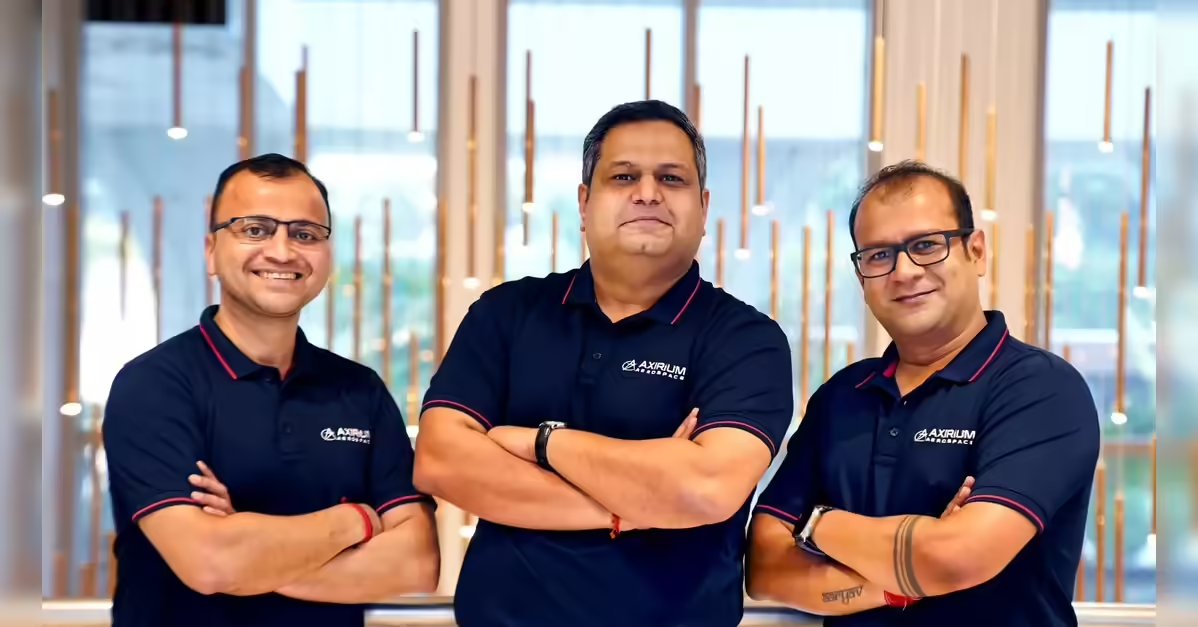
Axirium Aerospace has raised US$3.5 million in a seed round led by Shastra VC and BEENEXT, marking a pivotal moment for India’s emerging aerospace manufacturing sector. The funding will support the development of a precision-engineering facility dedicated to producing advanced aerospace components—a capability that remains limited across the country. As India seeks to scale its defence and aerospace ecosystem, Axirium’s entry illustrates how homegrown startups are stepping into a strategically important domain traditionally dominated by global suppliers.
A nascent but critical frontier for India’s industrial growth
India’s aerospace ambitions have expanded steadily over the past decade, driven by rising defence needs, commercial aviation growth, and increasing interest in satellite and space technologies. Yet despite this momentum, India’s domestic aerospace-manufacturing capacity remains underdeveloped. Much of the supply chain for high-precision components continues to rely on imports, creating bottlenecks that affect project timelines, cost structures, and national self-reliance goals.
Government agencies such as the Ministry of Defence of India have stressed the importance of strengthening domestic manufacturing under initiatives aligned with national security, industrial capability building, and long-term strategic autonomy. Similarly, aerospace infrastructure programs supported by bodies like the Department of Space have encouraged investment in advanced materials, machining, and component-level innovation. However, India still lacks a broad base of companies specializing in the ultra-high precision needed for modern aerospace systems.
Against this backdrop, Axirium Aerospace’s emergence reflects a growing recognition among investors and policymakers that India must expand its manufacturing footprint at the component level—not just in assembly or mission operations. Startups capable of delivering world-class engineering will play a pivotal role in enabling the country to compete more effectively in global aerospace supply chains.
Building precision capability to support national aerospace needs
Axirium Aerospace’s seed funding arrives at a critical time for India’s aerospace ecosystem. As defence procurement, satellite launches, and commercial aviation needs accelerate, the demand for high-quality components has grown rapidly. Precision engineering forms the backbone of aircraft assemblies, propulsion systems, avionics hardware, and spaceflight structures, all of which require machining tolerances and materials expertise that few companies in India currently possess.
By establishing a dedicated precision-manufacturing facility, Axirium aims to bridge this capability gap. The company intends to produce advanced components that meet global aerospace standards—an essential step for integrating into international supply chains and supporting indigenous aerospace programs. Such infrastructure could reduce dependence on imported parts, lower costs for domestic manufacturers, and improve reliability for mission-critical operations.
The investment from Shastra VC and BEENEXT also demonstrates rising investor confidence in deep-tech manufacturing ventures. Unlike software-led startups, aerospace-manufacturing companies face longer development cycles, higher capital requirements, and stringent regulatory environments. The willingness of early-stage investors to back Axirium indicates a maturation of India’s deep-tech funding landscape and growing recognition of the strategic value of hardware-focused innovation.
For India’s broader industrial ambitions, the rise of specialized manufacturing startups is key. Precision-component production is foundational not only for aerospace but also for adjacent sectors such as defence hardware, satellite equipment, and advanced robotics. As India strives to position itself as a global hub for sophisticated engineering, companies like Axirium will help elevate national capabilities across multiple high-value sectors.
A turning point for India’s aerospace industrial base
Axirium Aerospace’s progress reflects a broader shift in India’s industrial strategy—one that prioritizes deep manufacturing capacity as a driver of technological independence. While India has achieved significant progress in satellite launches, aircraft maintenance, and commercial aviation infrastructure, the country’s industrial base must evolve to support high-precision, high-reliability engineering essential to modern aerospace systems.
The emergence of precision-focused startups illustrates a transition from assembly-centric approaches to component-level value creation. This shift is especially important as India expands local production under national initiatives aimed at strengthening defence readiness and reducing reliance on foreign suppliers. Establishing a strong industrial foundation not only accelerates project timelines but also enhances India’s credibility as a reliable partner in global aerospace programs.
Axirium’s ambitions also reveal the growing role of startups in shaping national technology ecosystems. Traditionally dominated by large state-owned enterprises and multinational corporations, India’s aerospace sector is now seeing participation from agile, innovation-driven teams capable of adopting new materials, processes, and manufacturing technologies. These startups may bring faster iteration cycles and greater flexibility as they contribute to building the next generation of aerospace infrastructure.
India’s aerospace manufacturing capacity moves toward expansion
As Axirium Aerospace advances its facility plans, India’s aerospace-manufacturing ecosystem is poised for deeper transformation. The company’s success may encourage more startups to enter high-precision engineering, creating a more competitive supply base for domestic and global customers. Over time, this expansion could enable India to reduce import dependency and develop integrated manufacturing clusters that support the entire lifecycle of aerospace components.
Continued government backing will be essential, particularly in areas such as workforce development, quality certification, and access to specialized materials. As agencies refine manufacturing standards and strengthen industry partnerships, collaboration between startups, research institutions, and established aerospace firms will play a crucial role in accelerating capability development.
In the long term, India could emerge as a regional hub for advanced aerospace manufacturing, supplying precision components to global aviation and space companies while supporting sovereign aerospace programs. Axirium Aerospace’s early entry into this sector positions it as a potential leader in a market that is set for substantial growth as India intensifies its focus on technology-driven industrial independence.
A foundational step for India’s aerospace future
Axirium Aerospace’s US$3.5 million seed round marks a significant milestone for India’s aerospace ambitions. By building a precision-engineering facility dedicated to high-quality components, the company contributes to a critical capability that has long remained underdeveloped in the country. As India strengthens its aerospace and defence-manufacturing ecosystem, Axirium’s emergence signals the rise of a new generation of engineering-driven startups committed to building strategic, globally competitive infrastructure.