



Korea–Singapore AI partnership strengthens regional innovation
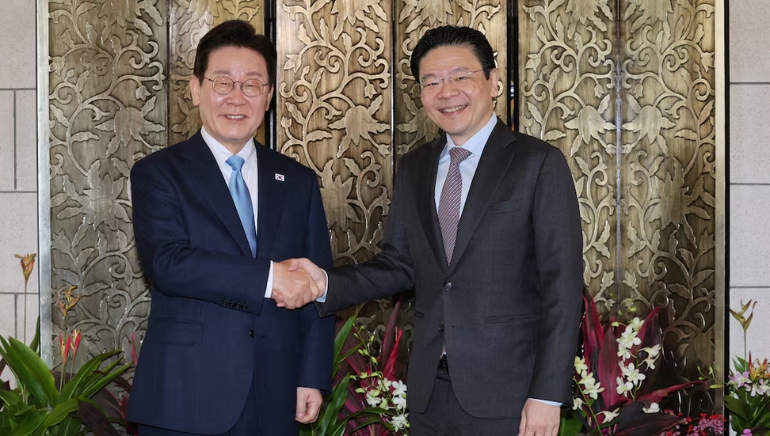
South Korea and Singapore have announced a $300 million joint initiative aimed at accelerating artificial intelligence research, startup development and cross-border technology collaboration. The partnership establishes a funding pool to support AI innovation, talent exchange and commercialisation projects across both countries.
The Korea–Singapore AI partnership reflects a growing recognition that regional collaboration is essential to compete in the global AI economy. By aligning research funding and policy frameworks, the two technology-focused economies aim to strengthen Asia’s influence in next-generation digital infrastructure.
Governments accelerate AI policy alignment
Both South Korea and Singapore have placed artificial intelligence at the centre of their national development strategies. Public policy initiatives increasingly target AI research, enterprise adoption and talent development.
In Singapore, agencies such as the Infocomm Media Development Authority (IMDA) and the National Research Foundation (NRF) have invested heavily in AI research programmes and digital infrastructure. Meanwhile, South Korea’s Ministry of Science and ICT (MSIT) and the Korea Institute for Advancement of Technology (KIAT) coordinate national technology investment and international partnerships.
Consequently, both governments view AI collaboration as a way to strengthen technological sovereignty while accelerating innovation.
The newly announced Korea–Singapore AI partnership expands existing research exchange initiatives and introduces a dedicated funding pool designed to support cross-border AI projects.
Moreover, the collaboration arrives at a time when global competition for AI leadership is intensifying across North America, Europe and Asia.
Therefore, coordinated regional investment can enhance Asia’s long-term competitiveness in the digital economy.
Research funding, startups and industry collaboration
The Korea–Singapore AI partnership will prioritise three core areas: research collaboration, startup funding and enterprise technology deployment.
First, a portion of the $300 million funding pool will support joint research programmes between universities and national laboratories. Collaborative projects may focus on machine learning, robotics, healthcare AI and advanced computing systems.
Second, the partnership aims to provide capital support for AI startups operating across both ecosystems. Emerging companies may gain access to funding, mentorship and market entry programmes.
Third, industry partnerships will encourage enterprise adoption of AI solutions in sectors such as finance, manufacturing and logistics.
Companies including Samsung Electronics, Naver, Grab and Sea Group operate major technology operations within the two countries’ digital ecosystems. These firms could benefit from expanded research networks and startup innovation pipelines.
Additionally, policy cooperation may streamline regulatory frameworks for AI testing and deployment.
Importantly, talent exchange programmes will help researchers and engineers collaborate across borders.
Thus, the Korea–Singapore AI partnership integrates funding, research and industrial development into a coordinated strategy.
Asia strengthens AI ecosystem collaboration
The global race for AI leadership increasingly depends on coordinated ecosystems rather than isolated national efforts. Governments are investing in research institutions, startup accelerators and compute infrastructure.
China, the United States and the European Union have launched large-scale funding programmes aimed at securing leadership in AI development.
Consequently, mid-sized innovation economies such as South Korea and Singapore are strengthening partnerships to maintain influence within the global technology landscape.
Both countries possess complementary strengths.
South Korea excels in advanced hardware manufacturing, semiconductor technology and robotics development.
Singapore, meanwhile, has built a strong reputation as a financial technology and digital services hub with robust regulatory frameworks.
Therefore, cross-border collaboration may accelerate commercialisation pathways for emerging technologies.
Nevertheless, the success of international AI partnerships often depends on effective governance structures and transparent funding allocation.
Regional collaboration defines next phase of AI leadership
The Korea–Singapore AI partnership highlights an important shift in global technology strategy. Rather than competing independently, many governments are forming alliances to pool expertise and financial resources.
Regional collaboration provides several advantages.
First, joint funding programmes expand access to capital for early-stage innovators.
Second, research collaboration accelerates knowledge exchange between institutions.
Third, policy alignment can reduce regulatory barriers that hinder cross-border innovation.
However, effective execution will determine whether such partnerships deliver long-term results.
Governments must ensure that funding reaches high-impact projects while maintaining accountability.
Furthermore, balancing national priorities with shared objectives can present governance challenges.
Ultimately, successful AI alliances depend on sustained commitment rather than short-term announcements.
AI alliances reshape Asia’s innovation landscape
In the near term, the Korea–Singapore AI partnership is expected to generate new research grants, startup funding programmes and academic collaborations.
Universities and technology institutes in both countries may begin joint research initiatives focused on advanced AI models and industry applications.
Over the medium term, the partnership could stimulate cross-border venture investment and startup expansion across Asia.
Additionally, enterprise adoption of AI solutions developed through the programme may accelerate digital transformation in finance, logistics and manufacturing.
Furthermore, talent exchange initiatives may strengthen the regional workforce by encouraging mobility among engineers, data scientists and researchers.
Looking ahead, collaborative AI ecosystems may become a defining feature of Asia’s technology landscape.
As global competition intensifies, strategic alliances between innovation-driven economies could determine the region’s long-term influence within the digital economy.
Strategic partnership strengthens Asia’s AI ambitions
The $300 million Korea–Singapore AI partnership marks a significant step toward regional collaboration in artificial intelligence research and commercialisation. By aligning funding resources, research institutions and startup ecosystems, the initiative aims to accelerate technological development across Asia.
As AI becomes increasingly central to economic competitiveness, partnerships that combine policy support, research capacity and entrepreneurial innovation will shape the next phase of global technology leadership.