


From pilots to production across Asia-Pacific enterprises
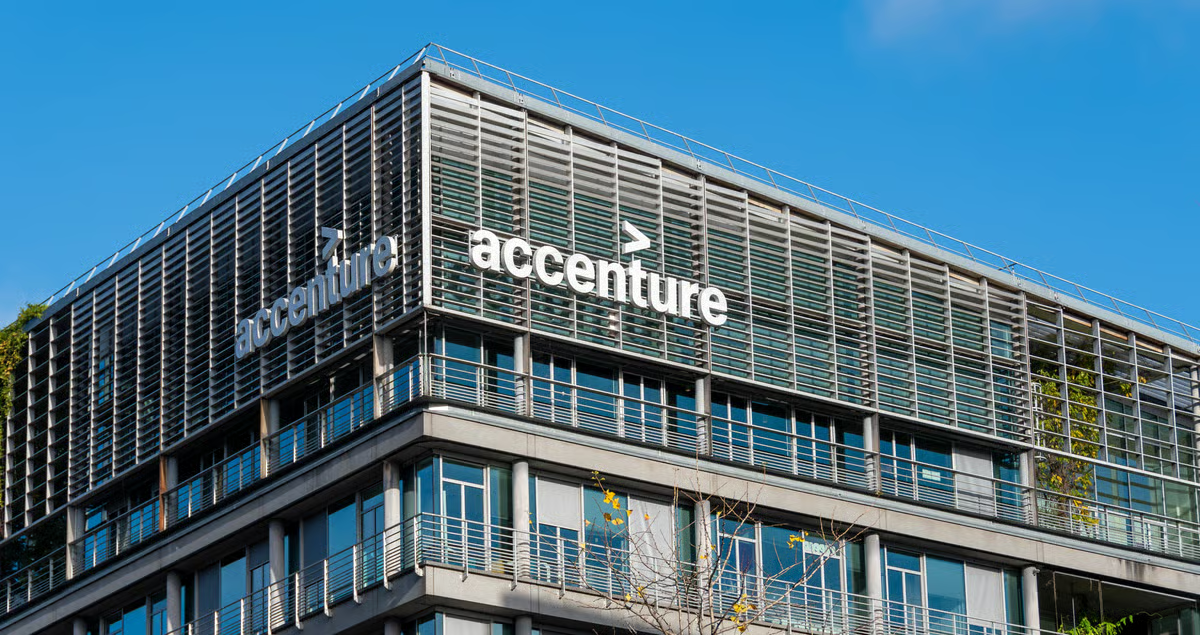
Accenture and Anthropic have expanded their multi-year partnership with a clear goal: help large organisations move beyond AI experiments and deploy AI at enterprise scale, including across Asia-Pacific. The centrepiece is a new Accenture Anthropic Business Group, which Accenture says will train about 30,000 professionals on Anthropic’s Claude models and tools. The tie-up also introduces a joint offering aimed at CIOs who want measurable value from AI inside engineering teams, not just demos. Taken together, the deal reflects a broader shift in the region. Boards across Asia-Pacific now treat AI as infrastructure, so they want governance, security, and delivery capability that matches that urgency.
Why this partnership matters now
Enterprise AI demand has moved faster than most organisations’ ability to absorb it. Many firms in banking, telecom, retail, and government have tested generative AI. However, scaling those pilots often stalls on the same bottlenecks: data access, model risk controls, procurement, and change management. In Asia-Pacific, that challenge can intensify because regional businesses operate across multiple regulatory regimes and languages.
This is where Accenture and Anthropic are placing their bet. Accenture brings delivery reach, system-integration muscle, and relationships with regulated industries. Anthropic brings Claude, a model family positioned around safer deployment and strong performance in enterprise workflows, including software work. In their announcement, the companies framed the expanded partnership as a way to turn AI into repeatable operating practice, not one-off projects.
The timing also aligns with a new enterprise focus on coding productivity. Anthropic highlighted Claude Code as a key part of the partnership’s engineering push, with Accenture positioning it as a tool that can sit inside large development organisations with governance and controls. That matters because software delivery sits at the centre of digital transformation, and it remains a pain point for many Asian enterprises racing to modernise legacy systems.
What the Accenture–Anthropic build actually includes
The most visible move is the creation of the Accenture Anthropic Business Group. Accenture says roughly 30,000 people will receive training on Claude. That scale suggests Accenture wants a deep bench of practitioners, not a small specialist unit. As a result, large clients can expect faster staffing and more consistent delivery across markets, including Asia-Pacific hubs where Accenture already runs major engineering and managed-services operations.
A second move is a joint, CIO-focused offering designed to measure value and drive large-scale adoption inside engineering organisations. The companies describe it as a structured path to put Claude tools at the centre of software development and maintenance. In practice, this is an attempt to solve the “ROI gap” that frustrates many leaders. CIOs want proof that AI improves velocity, quality, and cost, so they need metrics, operating models, and governance frameworks that can survive audit scrutiny.
A third move is verticalisation for regulated industries. The partners said they will co-develop solutions for financial services, healthcare, life sciences, and public sector use cases, where security and governance needs are strict. That focus fits Asia-Pacific realities, because banks, insurers, and government agencies often lead AI spend but also face the highest compliance burden. If the partnership works, it could shorten the time between “approved pilot” and “production deployment” in exactly those cautious sectors.
Why this matters for Asia-Pacific adoption
This partnership stands out because it targets the hardest part of the AI journey: scaling. Many Asia-Pacific enterprises already have access to models. What they lack is an end-to-end mechanism that combines tooling, training, governance, and delivery capacity across many business units and geographies. Accenture is trying to sell that mechanism as a repeatable service, while Anthropic is trying to embed Claude deeper into enterprise workflows through a major integrator channel.
It also signals a change in how consulting firms commercialise AI. Instead of positioning AI as a generic “innovation layer,” Accenture is tying it to specific work streams that enterprise leaders can fund and track, such as software engineering productivity and regulated-industry deployments. Meanwhile, Anthropic benefits because enterprise adoption often follows trust. When a model provider is paired with a delivery partner that already runs core systems, procurement resistance drops.
For Asia-Pacific, the likely near-term impact is practical. More clients will see packaged programmes that combine Claude access with operating models and governance, rather than buying model access alone. Over time, that could lift baseline AI maturity across the region, especially among firms that have budget but lack specialist AI product teams.
What success will look like in 2026
The partnership’s promise will face a simple test in the next year: can it produce measurable outcomes at scale? If CIOs can show shorter release cycles, lower defect rates, faster incident resolution, and safer model use under policy, then demand should grow quickly. If outcomes remain mixed, clients may keep AI in a “tool trial” phase, which would slow enterprise rollouts across Asia-Pacific.
Two execution risks will matter. First, governance needs to be consistent across markets. Asia-Pacific firms operate across data-residency rules and sector regulators, so “one template” rarely fits all. Second, talent adoption needs to stick. Training 30,000 professionals is only the start. Accenture must keep skills current as models and tools evolve, and it must turn training into delivery quality that clients can feel.
If the partnership clears these hurdles, it could accelerate a broader shift. Asia-Pacific enterprises may move from buying AI products to buying AI operating capability, where tooling, security, and delivery come bundled. That would reshape budgets, vendor selection, and the pace of transformation across the region.
A commercial blueprint for scaling enterprise AI in Asia-Pacific
Accenture and Anthropic are framing their expanded partnership as a blueprint for moving enterprise AI from pilots to production. The new business group, the large-scale training push, and the CIO value framework all point to the same message: AI adoption will not hinge on model access alone. It will hinge on delivery systems that enterprises can govern, measure, and repeat across markets. For Asia-Pacific organisations that want speed without chaos, this collaboration could become one of the more influential commercial routes to enterprise-scale AI in 2026.