

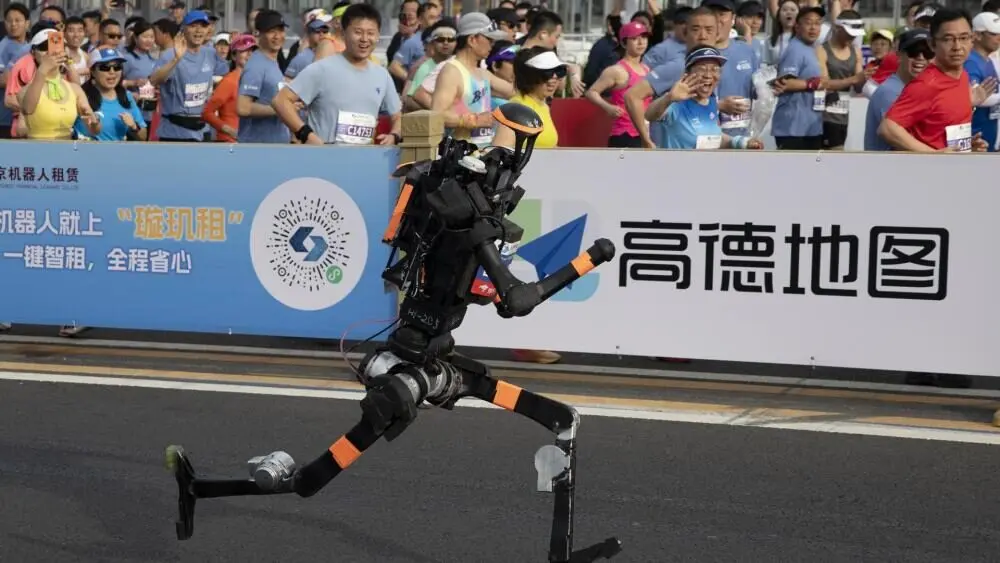


China humanoid robot marathon highlights real-world AI advancement
Beijing recently hosted a humanoid robot half-marathon, organized with support from the Beijing Municipal Government and local technology authorities, where dozens of robots competed in a long-distance race. Leading Chinese robotics companies such as Unitree Robotics, UBTECH Robotics, and Fourier Intelligence participated, showcasing their latest humanoid systems in a live competitive setting.
The China humanoid robot marathon highlights a new phase of AI development. Robotics is no longer limited to controlled settings, as companies test performance in dynamic, unpredictable conditions.
Consequently, the event signals China’s growing ambition to lead in advanced robotics and embodied AI systems.
China accelerates robotics and AI integration
China has been investing heavily in robotics and artificial intelligence. Government support, private capital, and industrial demand have driven rapid innovation.
Humanoid robots have become a key focus area. These machines are designed to replicate human movement and operate in complex environments.
At the same time, advances in AI models, sensors, and hardware have improved robot capabilities. Companies can now build systems that navigate, balance, and interact more effectively.
Meanwhile, robotics is gaining importance across industries. Manufacturing, logistics, and service sectors are adopting automation at scale.
Therefore, public demonstrations like this marathon reflect broader technological progress.
Real-world testing of robotics capabilities
The China humanoid robot marathon served as a large-scale testing platform.
Robots were required to complete a long-distance race. This tested endurance, balance, and adaptability in real-world conditions.
In addition, the event allowed developers to evaluate performance outside controlled environments. Factors such as terrain, weather, and crowd interaction created new challenges.
Meanwhile, companies used the event to showcase technological progress. Demonstrating real-world capabilities helps attract investors and partners.
The marathon also highlighted collaboration. Multiple organizations participated, contributing to a shared ecosystem of innovation.
As a result, the event functioned as both a competition and a demonstration of progress.
Robotics shifts from prototype to deployment
The China humanoid robot marathon reflects a broader transition in robotics development.
For years, progress was measured through lab-based benchmarks. However, real-world deployment is now becoming the key focus.
Testing robots in dynamic environments reveals practical limitations and opportunities. It also accelerates improvements in hardware and software integration.
At the same time, public demonstrations increase awareness. They help build confidence in robotics technologies among businesses and consumers.
However, challenges remain. Reliability, cost, and scalability are still critical issues that developers must address.
Therefore, events like this are important steps toward commercialization.
Humanoid robotics to expand across industries
Looking ahead, humanoid robots are expected to play a larger role in multiple sectors.
Several factors support this trend:
- Advances in AI and machine learning
- Improvements in sensors and hardware design
- Growing demand for automation
- Increased investment in robotics startups
China is likely to continue hosting similar events. These initiatives can accelerate innovation and attract global attention.
Meanwhile, companies will focus on practical applications. Robotics solutions in logistics, healthcare, and services are expected to expand.
Therefore, real-world testing will remain a key driver of progress.
Beijing event signals next phase of robotics innovation
The humanoid robot half-marathon in Beijing marks a significant milestone in the evolution of robotics. By moving testing into real-world environments, developers are accelerating progress toward practical deployment.
As AI and robotics continue to converge, such demonstrations will shape the future of automation. The China humanoid robot marathon highlights how innovation is transitioning from concept to real-world impact.