



India airspace advisory disrupts Asia–Europe aviation routes
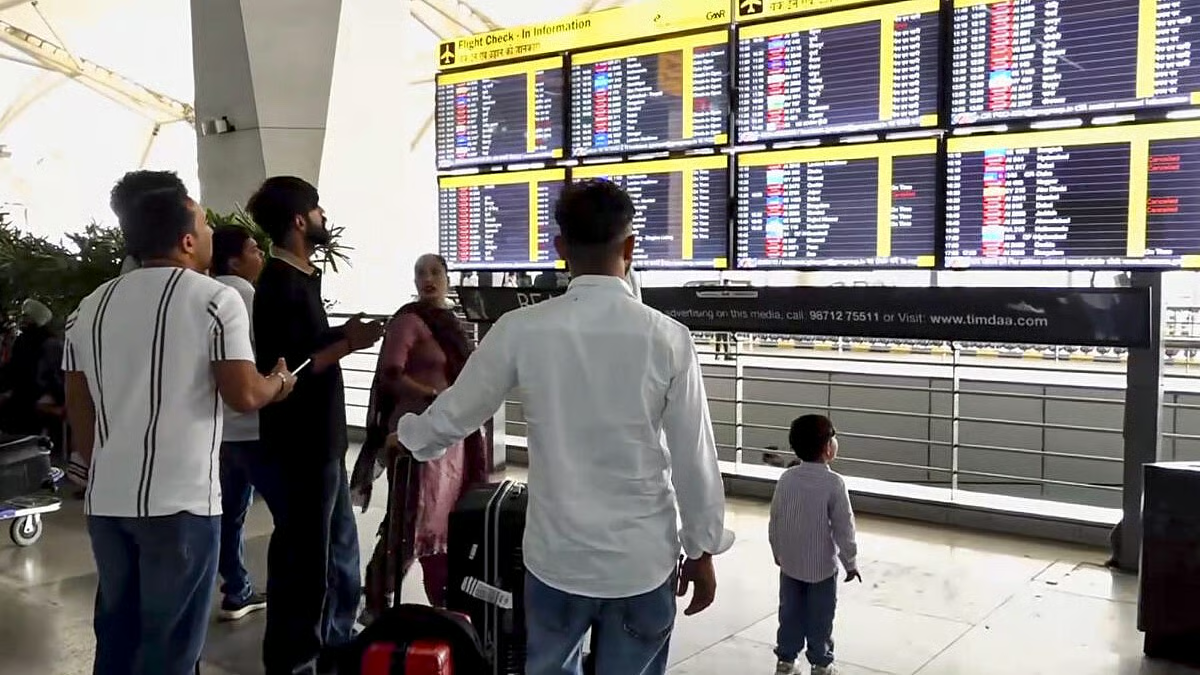
India’s aviation regulator has issued an airspace advisory urging airlines to avoid multiple West Asian airspaces, triggering potential disruptions across international flight routes. The move is expected to impact travel between Asia and Europe, increasing flight times, operational complexity, and costs for airlines and passengers.
The India airspace advisory impact highlights how geopolitical developments can quickly reshape global aviation networks. Airspace restrictions in key transit regions force airlines to reroute flights, affecting schedules, fuel consumption, and pricing.
Consequently, the advisory underscores the fragility of global connectivity and the need for airlines to remain operationally flexible in a rapidly changing environment.
West Asia’s role in global aviation corridors
West Asia serves as one of the most critical transit regions in global aviation.
Air corridors passing through countries such as the United Arab Emirates, Iran, Iraq, and Saudi Arabia connect major hubs across Asia, Europe, and North America.
Airlines rely on these routes to minimize travel time and optimize fuel efficiency.
Regulatory bodies such as the Directorate General of Civil Aviation (DGCA) India and global organizations like the International Civil Aviation Organization (ICAO) monitor airspace safety and issue advisories when necessary.
Recent geopolitical tensions and security concerns in parts of West Asia have led to increased caution among regulators.
As a result, airlines are being advised to avoid certain airspaces to ensure passenger safety.
However, such measures come with operational trade-offs.
Rerouting flights often leads to longer flight paths, increased fuel usage, and scheduling challenges.
Airlines reroute operations and adjust capacity
Following the India airspace advisory, airlines are actively adjusting their operations to maintain service continuity.
These adjustments include:
- Rerouting flights through alternative air corridors
- Increasing fuel loads to accommodate longer routes
- Revising flight schedules and turnaround times
- Managing crew rotations and operational logistics
Longer routes can add significant time to flights between Asia and Europe.
This not only affects passenger experience but also increases operating costs for airlines.
Fuel costs, which represent a major portion of airline expenses, may rise due to extended flight durations.
In response, airlines may consider adjusting ticket pricing or capacity to manage profitability.
Some carriers may also prioritize high-demand routes to maintain efficiency.
Global airlines adapt to shifting airspace dynamics
The India airspace advisory impact is being felt across the global aviation industry.
Airlines from Europe, Asia, and the Middle East are all adjusting their networks in response to changing airspace conditions.
Major carriers such as Lufthansa, Air France-KLM, Emirates, and Qatar Airways are recalibrating routes to ensure safety and operational continuity.
At the same time, Asian carriers including Air India, Singapore Airlines, and Cathay Pacific are adapting to maintain connectivity with European markets.
The situation highlights a key industry dynamic.
Airspace availability is a critical factor in airline operations, and disruptions can quickly alter competitive positioning.
Airlines that adapt more efficiently may gain an advantage in maintaining reliability and customer trust.
Aviation resilience tested by geopolitical uncertainty
The India airspace advisory reflects a broader challenge facing the aviation industry.
Global air travel depends on stable geopolitical conditions and open airspace.
When disruptions occur, airlines must respond quickly to maintain operations.
This requires a combination of strategic planning, operational flexibility, and technological support.
Advanced route planning systems and real-time data analytics help airlines optimize flight paths and minimize disruption.
However, the unpredictability of geopolitical events makes long-term planning more complex.
For passengers, these disruptions may translate into longer travel times and higher ticket prices.
For airlines, they represent a test of resilience and adaptability.
Airspace disruptions may reshape global routes
Looking ahead, continued geopolitical uncertainty could lead to further adjustments in global aviation networks.
Airlines may explore alternative routing strategies to reduce reliance on specific transit regions.
In addition, investments in fuel-efficient aircraft and advanced navigation technologies may help mitigate the impact of longer routes.
Governments and international organizations may also work to enhance coordination and communication to ensure safe and efficient airspace management.
For India, the advisory reflects a proactive approach to safety.
However, it also highlights the interconnected nature of global aviation.
Changes in one region can have ripple effects across international travel networks.
India advisory underscores aviation’s vulnerability to disruption
India’s airspace advisory demonstrates how geopolitical developments can quickly disrupt global aviation routes. By urging airlines to avoid certain West Asian airspaces, regulators are prioritizing safety while triggering operational adjustments across the industry.
As airlines adapt to these changes, the incident serves as a reminder of the importance of resilience and flexibility in maintaining global connectivity. The aviation sector will continue to evolve as it navigates an increasingly complex and dynamic global environment.